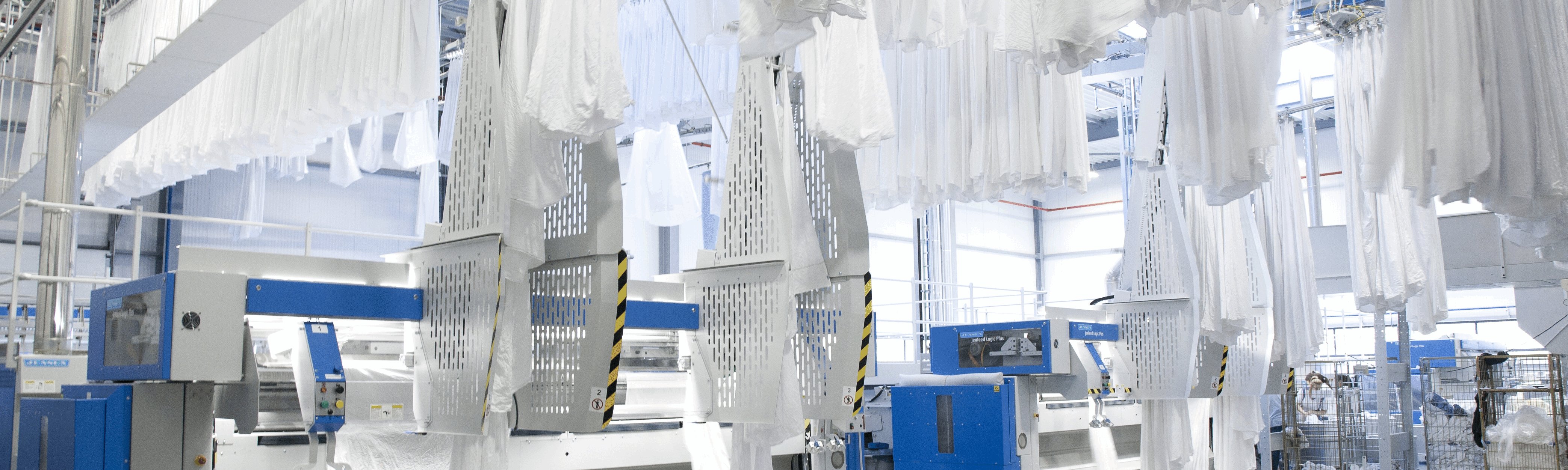
Double capacity per ironing line thanks to remote cornerless feeding of sheets into two lanes
Xin Wen Yu Chuang Xin
In order to eliminate the risk of exposing operators in the laundries to germs from soiled hospital linen, the sorting of soiled hospital linen was prohibited in some countries decades ago. This spawned the post-sort operation requiring mixing goods to be washed together, then sorted. As a result, JENSEN invented the Jenrail conveyor system allowing operators to load unsorted, washed and clean flatwork into clamps in front of the feeder, and sort it into sorting lines before feeding it into the feeder via deloading stations.
Increased feeding capacity
As an added bonus of introducing sorting lines between the loading stations and the feeder, and thereby position the loading stations away from the feeder, it was possible to increase the number of loading stations, and thus the number of operators feeding linen into the system. As a result, the feeding capacity went up dramatically, which was putting a strain on the ironer line.
2000 pieces per hour
JENSEN responded to the challenge by changing the way of processing the flatwork in the ironer lines. Instead of running in 1-lane operation, which was the conventional way of operating the majority of ironer lines at that time, JENSEN introduced 2-lane operation. As a result, the capacity of one ironer line was theoretically doubled over night. In order to realize the higher capacity of the ironer line, the number of loading stations and thus the number of operators feeding flatwork into the system was increased from typically 3 or 4 persons to 5, 6, or sometimes even 7 operators. With 6 or 7 operators feeding 250-300 sheets per hour, the number of sheets being processed in the ironer line went up from typically 1000 single hospital sheets per hour to 2000 or more.
Reduced soil sorting and less idle time
With the Jenrail system’s capability of automatically sorting linens, the need for manual sorting could be reduced or eliminated.
Another advantage of the Jenrail system is the continuous feeding of sorted flatwork. Thanks to the automatic sorting according to linen type and size, the number of program changes can be reduced dramatically. By reducing the number of program changes, the idle time is reduced, thus increasing the total capacity as a result.
Furthermore, the buffer of ready linen reduces the number of micro stops by allowing operators to continue feeding linen into the buffer lines while e.g. waxing the ironer. Without the Jenrail system, the operators will have to wait for the waxing to be finished before they can carry on feeding the linen into the ironer.
Double storage capacity per rail meter
In order to optimize the storage capacity of the Jenrail conveyor system, JENSEN took a radical decision; instead of clipping two corners of linen into two single clamps, allowing to store 5 pieces of linen per rail meter only, JENSEN developed the unique Twin clamp allowing one clamp carriage to hold the two corners of linen side-by-side. In this way the storage capacity per rail meter is doubled. As an added bonus of using one clamp carriage per linen instead of two separate single clamps, the transportation through the Jenrail system is safer and simpler, as there is no risk of two corners of linen being separated in the switch tracks.
Spread the word…
Over time the advantages of the automatic sorting concept spread to the entire laundry industry, including the hospitality segment. Today the decentralized feeding concept is no longer used in the healthcare segment only. Laundries all over the world see the benefit of increasing the automation and thus the PPOH by automatically sorting the flatwork before feeding it into the ironer line.
Double PPOH by cornerless feeding
Also, within decentralized feeding, there is a continuous focus on increasing the PPOH. JENSEN has responded to the challenge by introducing cornerless feeding of sheets. Cornerless feeding doubles the capacity per operator hour from typically 250-300 pcs. to more than 500 pcs. per operator hour.
Several laundries around the world report production figures of 500 to 600 single hospital sheets per operator hour thanks to the cornerless feeding. As a result, we see production rates of up to 2,400 single hospital sheets per hour in 2 lanes, fed by only 4 operators, which is a world record in our industry.
In short, if you have any specific needs, we will gladly help you come up with the correct and most productive solution for your laundry.
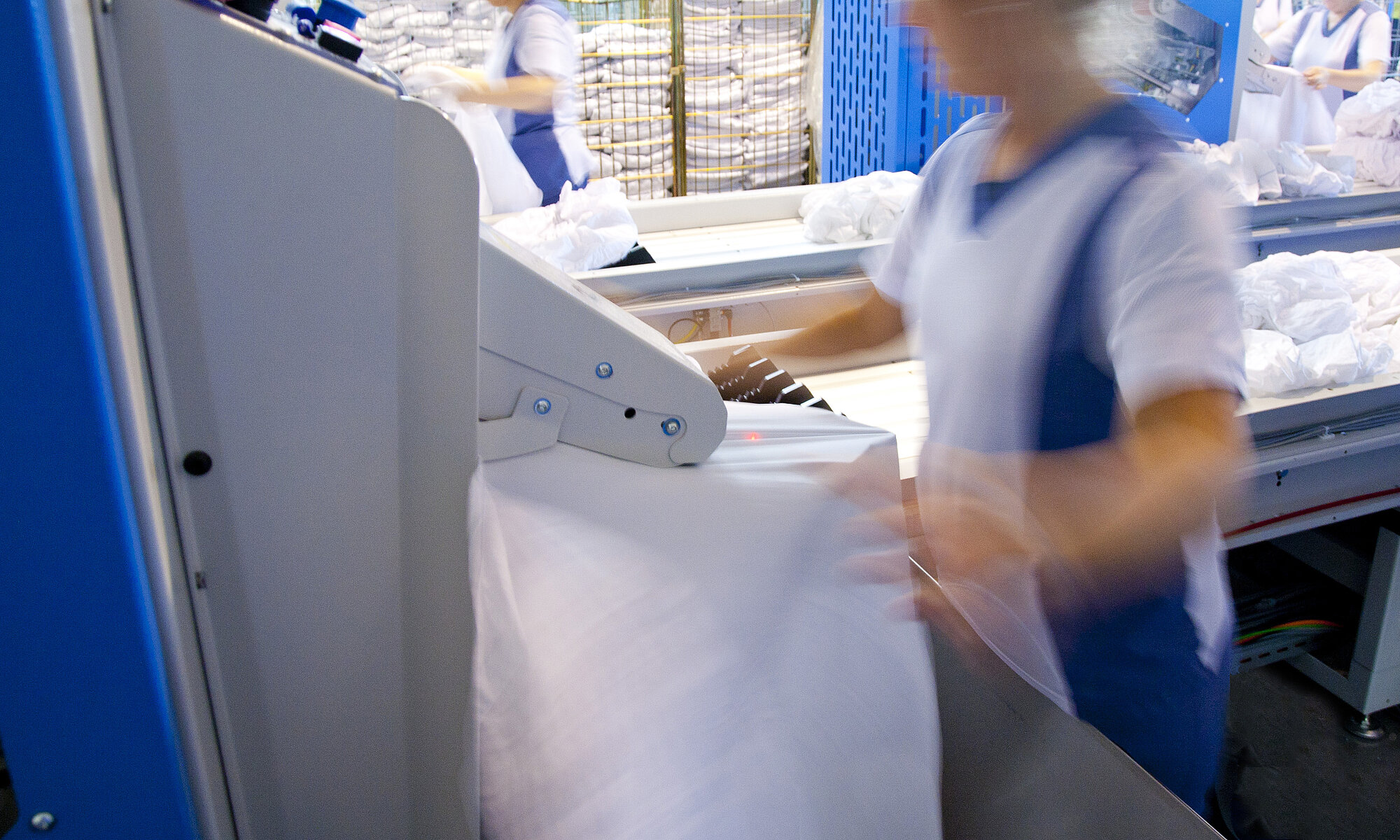
Double capacity per operator thanks to cornerless feeding
 八月 2026
  八月 2026
 2026 年上半年业绩体现了全球洗涤企业对JENSEN-GROUP一如既往的信任:集团上半年营收增长 20.2%,达到 3.162 亿欧元。上半年新接订单额同样创下亮眼新高,总额达 2.792…
 七月 2026
 With state-of-the-art laundry technology, continuous investments, and a clear vision for the future, STIMPFL TEXTILE CARE GmbH in Tyrol is consistently driving its…
 六月 2026
 列支敦士登公国地处阿尔卑斯山脉腹地,毗邻各大国际化经济区域。坐落于Balzers的FIX AG公司,与Wallisellen的Textil-Service FREI…
 六月 2026
 自 5 月 5 日起,新成立的 J4B 公司将作为JENSEN-GROUP官方授权本地合作商,负责JENSEN 在捷克共和国与斯洛伐克全境业务,公司总部设立于布拉格附近的Stochov。该企业由Otto Burger与其弟弟Jan Burger共同运营,二人深耕当地洗涤行业多年,掌握丰富市场经验,同时拥有深厚行业人脉资源。

