Gijutsuteki Kiji
Even in modern industrial laundries, many routines and processes are still heavy, dirty, and potentially dangerous. Especially repetitive tasks often result in employees making mistakes; some of which can be extremely costly. Fortunately, the industry’s leaders recently focused on the development of new solutions such as robots, artificial intelligence and data management.
Sorting soiled garments is one of the routine tasks where the use of advanced technologies can reduce human interaction to an absolute minimum.
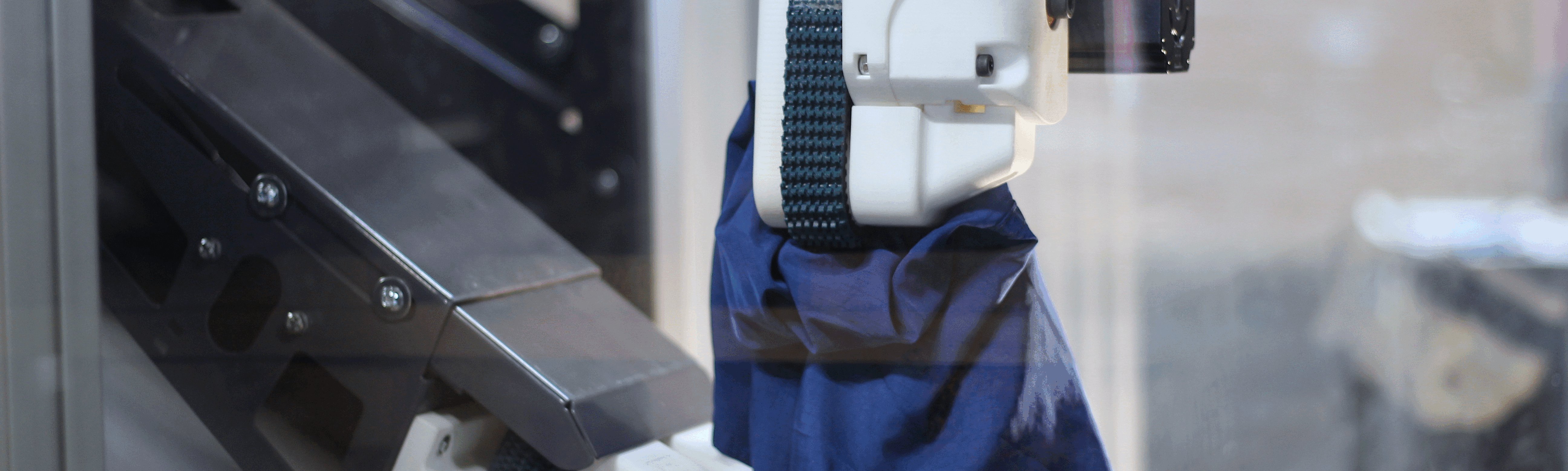
Robots pick up the individual laundry pieces from conveyor belts and transport them to RFID chip readers to identify and register each garment. Directly after that, an X-ray scanner automatically detects unwanted hidden objects in the pockets and rejects these contaminated garments. Only approved laundry articles are forwarded further to be sorted accordingly by the system.
Today, all these tasks can be performed by only a few operators who have to manually empty the pockets of the rejected garments.
Occupational safety through X-ray technology
The X-ray scanner also functions perfectly as a stand-alone device: it checks soiled laundry pieces for dangerous foreign items and creates a safe and efficient working environment. With X-ray technology, harmful foreign sharps such as needles, scissors, scalpels, etc. can no longer remain undetected in the pockets.
From human intelligence to artificial intelligence
However, humans are not that easy to replace, as the combination of body and brain is reasonably smart. Robots on the other hand, only do what you tell them to, and that is why building intelligent robots take the best people, you can find. When you have their brains at hand, you can begin working with artificial intelligence, AI.
AI is when you build a computer like a small brain. You teach it by giving it a lot of relevant data with the right solutions. The more patterns the computer can learn, the better. An example are systems based exclusively on visual sorting and mainly used for unmarked garments.
Almost all advances in AI have been made lately when specific input data is used to generate a simple response. If a typical person can do a mental task with less than one second of thought, we can probably automate it now or soon with the help of AI.
With these machines, laundries can perform more demanding and specialized tasks, where robots perform recurring tasks while human operators can take care of customer-related tasks.
The laundry industry is entering a new era in which technology can take over most production processes without human interaction. Together with our partner Inwatec, the JENSEN-GROUP is once again shaping the future of the laundry industry. These latest innovations in robotics and artificial intelligence increase the IQ and productivity in laundries.
 4月 2026
 本号のEspresso Insightsでは、ウィリー・デ・カルヴァーリョ氏にお話を伺い、効率的で将来を見据えたランドリーレイアウトの設計方法や、見えにくい課題をどのようにしてスマートな解決策へと変えているのか、そして各プロジェクトを形にすることのやりがいについて探りました。
2月 2026 本号の Espresso Insights では、Scarlet Janssens に、JENSEN-GROUP 財務チームで働く魅力、現在投資家が JENSENを最も評価している点、そしてトレジャリー管理が同社の長期的なイノベーションおよび成長戦略をどのように支えているかについてお話を伺いました。
1月 2026 今回のEspresso Insightsでは、Jesper Hansenにお話を伺い、JENSENが産業用ランドリーで卓越したカスタマーサービスを提供する方法、デジタルツールの役割、そして人材不足という将来の課題への準備について探りました。
11月 2025 JENSEN-GROUP のイノベーションの中心には、持続可能性への強いコミットメントがあります。私たちは、企業サステナビリティ責任者であるカルメラ・クリッパ氏にインタビューし、同社が気候行動と高度なランドリー自動化をどのように融合させているかを明らかにし、JENSEN…
10月 2025 Laurent Maillardは、イギリス・バンベリーに拠点を置くJENSEN UKのゼネラルマネージャーです。イギリスは紅茶文化で有名ですが、今回は一緒にエスプレッソを楽しみました。

