专家网志
In 2008, JENSEN introduced the CleanTech concept and pioneered a totally new approach for the laundry industry. Dan Munch, Product Development Manager with JENSEN Denmark, explains how all engineering activities have become greener.
Dan Munch reflects for a brief moment before answering the question of what it would have looked like for JENSEN if the company had not been at the forefront of the development and launched the CleanTech strategy, which runs throughout the company:
“We would not be able to meet the needs of our customers. Many years ago, we had no urgent reason to do anything about energy optimization, but we could see the need for such a development coming. That’s why the JENSEN-GROUP laid out a strategy for sustainability, which is compiled under the name CleanTech.
Initially, most markets were not asking for CleanTech solutions. However, within the past couple of years, it has really caught on, especially in Southern European countries. Local regulations have been imposed on laundries, and that’s what drives them to seek the solutions now. They must be able to document to the authorities that their suppliers meet the new requirements being set. We have sent a lot of documentation detailing our processes. In reality, we knew all along which direction the wind was blowing, so we were early to ask our customers if they would benefit from the company’s new initiatives.”
“We are satisfied that the market has opened up to green solutions. We have been continuously analyzing: Would it create value for our customers if we launched more energy-efficient products? Would they pay for it? Laundries are increasingly seeing the need, also because governments are giving pressure”.
About CleanTech
CleanTech is not just about the function of the industrial laundries JENSEN supplies equipment to, but about the whole process behind it, Dan Munch explains:
“We generally think about energy efficiency and work with high-efficiency motors. Every year, we strive to improve on all products in terms of gas and air consumption - which consumes a lot of energy - and electricity in general. We also look at where the steel we use comes from. What quality does it have, how is it manufactured, is it produced in countries that have a completely different standard than we use here?
In addition, JENSEN Denmark invests in recycled plastics for its production process. This has proven to be a challenge: In Denmark, 400,000 tonnes (881,849,000 lbs.) of plastic are produced annually, while only 50,000 tonnes (110,231,000 lbs.) are recycled. This is not enough to meet the demands of JENSEN Denmark, and therefore their suppliers must retrieve recycled material in Sweden and the Netherlands, where plastic recycling is much further ahead. We also have to consider transport costs - green as well as economic - against the effect of recycling. That calculation is still correct, though there is no saving to reuse.
The price of new plastic compared to recycled is the same. There is no difference. So, we do not do this to save money, but because it is our goal that we want to recycle as much as possible.
The long-term strategy is now catching up with customers, which is why the development manager is still working to find new solutions that can improve the company's green competitive environment before being overtaken by regulations.”
CleanTech in the 20’s and beyond
“We must prepare for what is to come. We are the market leaders, so we must also be the leader in green solutions. We are very conscious of our position and the task it gives us to be a leader: We need to help push development forward, and because of our size, we have the opportunity to increase the speed of that development.”
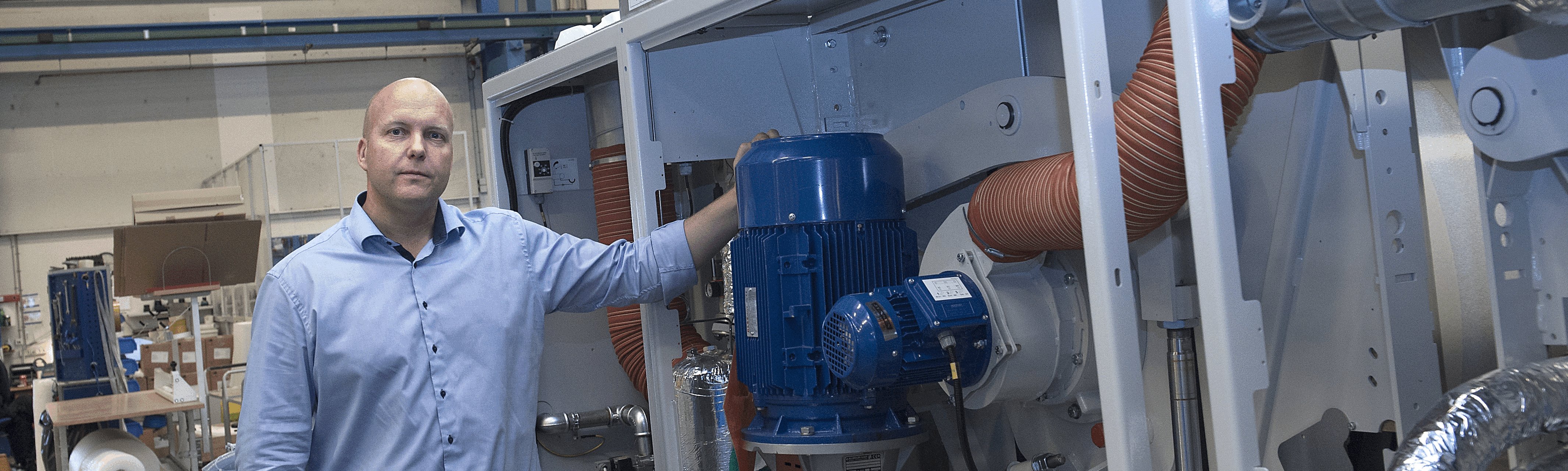
This article is an extract from an interview with Dan Munch that was originally published in “Bornholms Tidende”, a publication from the Danish island of Bornholm. Dan Munch has been working with JENSEN Denmark, the JENSEN-GROUP’s competence center for flatwork finishing technology, for more than 20 years and is in charge of Product Development. The ideas that he created together with his team can be seen in JENSEN’s flatwork finishing machines.
 一月 2026
 在本期Espresso Insights中,我们与Jesper Hansen展开简短访谈,共同探讨JENSEN-GROUP如何为工业洗涤行业客户提供卓越服务、数字化工具所发挥的作用,以及集团如何应对未来技能人才短缺的挑战。
十一月 2025 可持续发展是JENSEN-GROUP创新的核心驱动力。我们与集团企业可持续发展负责人Carmela Crippa展开对话,深入探寻公司如何将气候行动与先进洗涤自动化技术相结合,揭秘JENSEN是如何通过远大目标与责任文化,推动行业迈向更绿色的未来。
十月 2025 Laurent Maillard是位于班伯里的JENSEN英国公司的总经理。尽管英国素来以茶文化闻名,但我们仍一起享用了一杯意式浓缩咖啡。
九月 2025 Keith拥有深厚的行业知识,并始终以助力客户成功为己任。他常驻新加坡,负责新加坡、越南、印度尼西亚、泰国部分地区、韩国和菲律宾市场的业务。在访谈中,他分享了关于未来规划的思考、自动化技术的实际应用现状,以及一个与客户业务同步成长的里程碑式项目。
 八月 2025
 工业洗衣厂目前面临诸多挑战:持续的人才短缺,尤其是夜班员工缺乏;工资成本上升;以及提高产能和运营效率的压力。手工处理脏布草既费力又耗时,而且很难配备人员,导致效率低下和产能受限。
我们的创新“暗工厂”方案彻底改变了洗涤厂的夜间作业,实现了洗涤分类与存储的全自动化,从而实现无人值守的生产。

