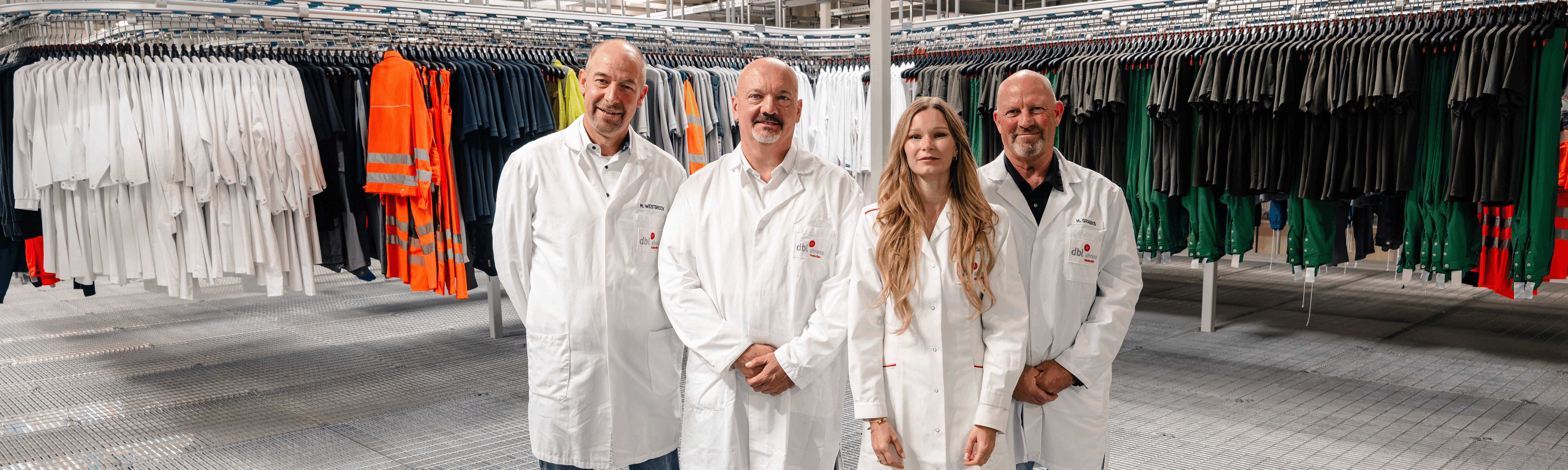
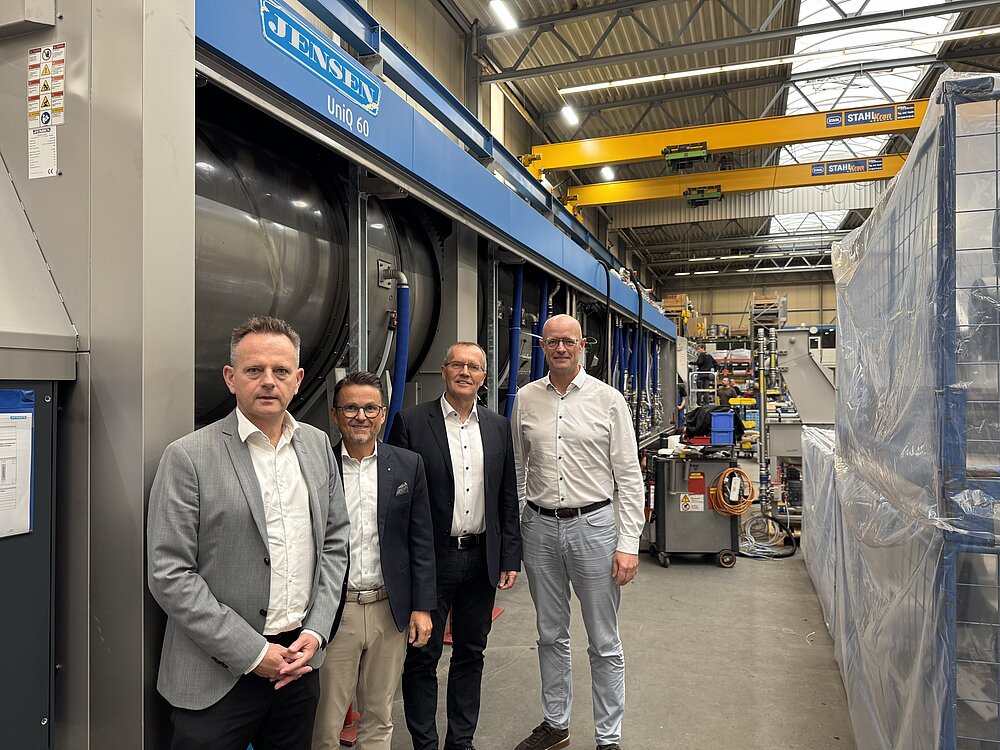
Her grandfather’s vision of a sorting system in the upper hall is now a reality. From left to right: Martin Westbrock (Operations Manager, DBL Ahrens), Bernd Krüger (Project Manager, JENSEN Germany), Anna-Elisabeth Hackl (Managing Director, DBL Ahrens) and Henning Grabis (Technical Manager, DBL Ahrens).
Nieuws & innovaties
At DBL Ahrens in Elmshorn, Northern Germany, automation has transformed the journey of every garment. Repetitive manual sorting has given way to robotic separation, intelligent identification and automatic foreign-object detection. On the clean side, an integrated Metricon system brings garments to employees and guides them through finishing, inspection, repair and sorting. Developed with JENSEN and Inwatec, the modernization connects the entire process while creating more ergonomic workplaces and room for future growth.
Five generations with an eye on tomorrow
Founded by Managing Director Anna-Elisabeth Hackl’s great-great-grandmother, Ahrens Textilservice GmbH draws on around 130 years of family history. A founding member of the DBL network since 1971, the company provides rental workwear and textile services to businesses across Schleswig-Holstein, Hamburg, northern Lower Saxony and the Weser-Ems region.
The company serves trade businesses, industrial companies, care providers, pharmaceutical companies, food producers, road construction companies and emergency services. Around 160 employees, including approximately 63 in production, support this broad customer base. Working across one and a half shifts, the laundry processes around 10’000 garments daily, alongside mats and thermal blankets.
In 2024, demographic change, recruitment challenges and increasing customer and industry standards requirements prompted a fundamental review of production. Two processing lines and frequent transport between separate production halls had created a complex flow with considerable manual handling.
“We asked ourselves how technology could help us prepare for the future,” explains Anna-Elisabeth Hackl. “We wanted ergonomic workplaces, reliable processes and the flexibility to meet changing customer requirements. That meant thinking through the whole laundry again. We needed a supplier who could provide solutions from start to finish, with technology already proven in daily operation. In the JENSEN-GROUP, we found that expertise.”
Robotic sorting changes the starting point
The transformation is particularly visible on the soiled side, where an automated sorting system from Inwatec combines robotic separation, intelligent identification and foreign-object detection. Incoming textiles arrive in a primary bag system and are emptied onto an inspection conveyor. A THOR robot continuously separates the workwear into individual pieces, handling at least 1’500 garments per hour and taking over a previously repetitive manual task.
HEIMDAL then identifies articles using RFID or camera-based classification. Trained to distinguish colours, patterns and textures, HEIMDAL.Camera enables automatic classification even where RFID tags are absent. This flexibility was important for DBL Ahrens, whose textile stock included a considerable share of barcoded garments. The installation therefore also incorporates Multifeed stations for manual single-piece infeed and barcode scanning when required.
Daily operation has since demonstrated how effectively camera classification supports the robotic route. The Ahrens team reports that it now processes even its barcoded articles predominantly through THOR and HEIMDAL.Camera, making much less use of manual infeed than originally anticipated.
“The camera sorting has surprised us very positively,” says Operations Manager Martin Westbrock. “It works so reliably that we are using the robotic process for far more articles than we initially expected.”
Smart detection, safer garment processing
Next, the ODIN X-ray scanner uses AI-based detection to identify potentially harmful foreign objects. Affected garments are automatically rejected for manual removal of the objects, helping protect employees, textiles and downstream equipment.
Employees experienced this capability first-hand during an internal celebration: everyone could bring an object to test the system. Seeing detection in action helped turn a technical installation into something the whole team could understand and appreciate.
Reversing conveyors subsequently direct garments into eight sorting categories. Complete batches are released into the classified Futurail bag system, comprising 65 bags with a capacity of 65 kg each.
Together, robotic separation, identification, inspection and overhead transport replace repeated manual handling with an organized flow towards the washroom.
Alongside the usual blue Futurail bags, distinctive red bags are immediately noticeable. These are reserved for thermal blankets.
Two tunnel washers with a personal connection
The Futurail bags transport the sorted soiled laundry to two JENSEN UniQ 75 tunnel washers, each with twelve compartments. In daily operation, one primarily processes coloured laundry, while the other handles white textiles and thermal blankets. Both machines, however, are designed to process all these textile categories, giving Ahrens maximum flexibility to allocate loads across either line.
For Anna-Elisabeth Hackl, the arrival of the first tunnel washer remains a particularly memorable moment. “When the first tunnel washer was brought into the hall, everything we had planned on paper suddenly became real. We could see our vision taking shape.”
The machines soon gained an even more personal significance. As a surprise for the opening, employees named them “Anna” and “Elisabeth” after their Managing Director, complete with their own nameplates.
Inside the UniQ tunnel washers, laundry moves from one compartment to the next in just four seconds, leaving more time for the actual washing process. QuickSoak provides an extra shower right at the start to thoroughly soak the textiles. This loosens dirt during the prewash, making it easier to remove in the subsequent washing process.
Both lines share a central water recovery system comprising four large EcoTanks. Recovered water is kept separate according to laundry colour, enabling a high rate of water reuse. LintEx 1000 supports water quality, and real-time visualization gives the team an overview of the washing process.
Two Z1300 Plus centrifuges remove excess water at forces of up to 800 G before the textiles proceed to four DT 90 Plus dryers. Controlled air recirculation and InfraCare heat control support efficient drying and careful textile treatment.
Garments come to the employee
On the clean side, the Turnus Separator automatically separates garments before loading, reducing the effort required to pull individual pieces from a batch.
Six MetriQ loading stations introduce garments into the Metricon system. Each station handles around 300 pieces per operator hour, combining the unique “buttons-to-the-front” loading concept with comfortable, quiet operation.
The change is immediately noticeable to employees. Garments arrive at the workstation, while clear screens help operators understand and manage their tasks.
“The garments come to us now, which is a clear game changer. The workplaces are more ergonomic, comfortable and intuitive, and new colleagues quickly experience that they can do the job successfully,” says Anna-Elisabeth Hackl.
Once loaded, garments travel through the five-compartment JENSEN Omega Pro Tunnel Finisher for fast, gentle finishing.
Every garment gets the attention it needs
Metricon continues to guide each garment through the following stages. At four quality inspection stations, employees add repair codes directly to a garment image, indicating precisely where attention is needed. That image appears at the repair stations, giving the repair team clear instructions without having to locate the fault again.
Garments needing special treatment, such as a name-tag change or removal from service, are automatically discharged through a lobster deloading station. The system directs these exceptions away from the regular flow so they can receive the appropriate attention.
Automatic presorting groups garments for efficient final sorting, after which Metricon arranges them according to delivery requirements. Two JENSEN Fox 1200 folders automatically feed and fold both light and heavy garments. Where required, garments are transferred from system hangers to delivery hangers using a lobster deloading station, ready for the next dispatch stage.
Working together, every step of the way
The modernization was completed in around eight months while production continued. Washing came first, followed by garment loading, finishing and sorting, and then the Inwatec installation. Fine-tuning, process optimization and the development of dashboards now continue as the team gains experience. Ahrens involved employees throughout, celebrating milestones and inviting everyone to try the new equipment.
For Anna-Elisabeth Hackl, choosing a supplier capable of connecting the entire process was essential. Visits to reference laundries and practical tests provided confidence in the technology. Close support from Bernd Krüger, Project Manager at JENSEN Germany, helped translate the requirements into a layout that made effective use of the available space.
“After the installation period, the technicians felt more like colleagues than external suppliers,” recalls Anna-Elisabeth Hackl. “Communication was direct, people were always approachable, and the promises made during planning were kept.”
Bernd Krüger shares that appreciation: “Everyone pulled together. The openness and commitment of the Ahrens team helped us turn a demanding modernization during ongoing production into a successful joint project.”
Designed for the next chapter
The benefits are already apparent in everyday work: less repetitive handling, more ergonomic stations and a clearer overview of production. “The employees are enthusiastic. Nobody wants to go back to the old way of working,” comments Martin Westbrock.
The layout also anticipates further development, including space for additional automation. For Anna-Elisabeth Hackl, one particularly personal ambition has become reality: “My grandfather always said that the upper part of the hall would one day accommodate a sorting system. Being able to realize that in my generation was a very special moment.”
With robotic sorting and connected garment handling now established, Ahrens continues to refine its processes and explore what comes next.
“We thought carefully about the future throughout this project. When technology, our employees and our customers’ needs come together, we have a strong model for the years ahead”, concludes Anna-Elisabeth Hackl.
The JENSEN-GROUP thanks the entire DBL Ahrens team for their trust, close collaboration and shared commitment to making this transformation a success.
Seeing is believing: Watch our video on YouTube to discover how DBL Ahrens combines intelligent automation with ergonomic workplaces and efficient processes, from incoming laundry to dispatch.
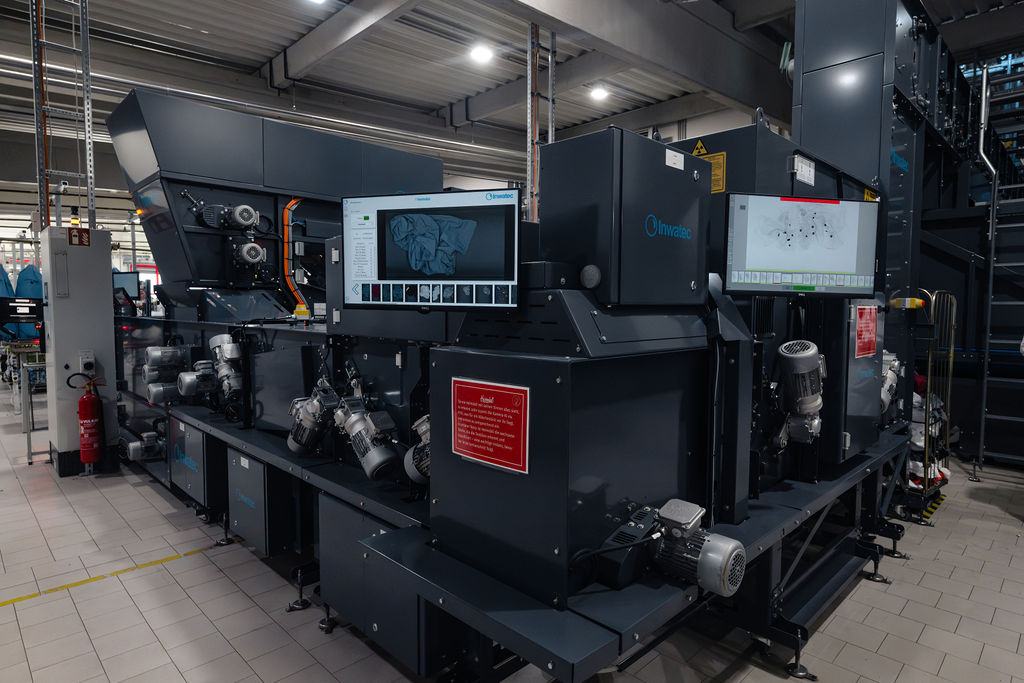
DBL Ahrens moves from manual handling to automated sorting with robotic separation, intelligent identification and foreign-object detection.

Designed for maximum flexibility, both UniQ tunnel washers can process all textile categories and share a central water recovery system with four EcoTanks.
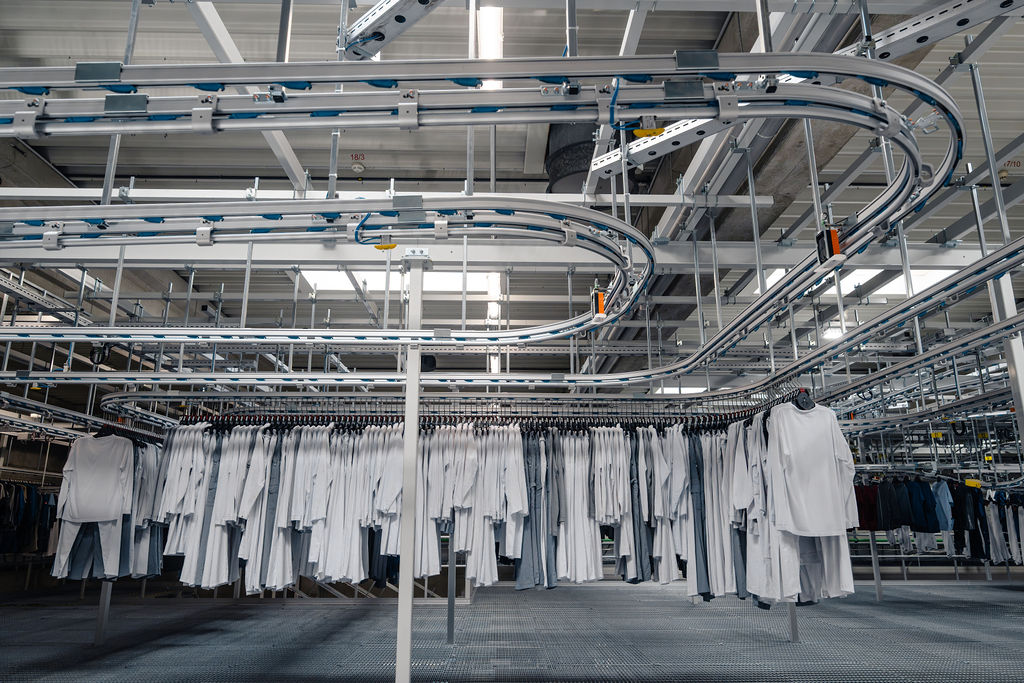
From ergonomic loading to inspection, repair and sorting, Metricon connects every stage of garment handling on the clean side.
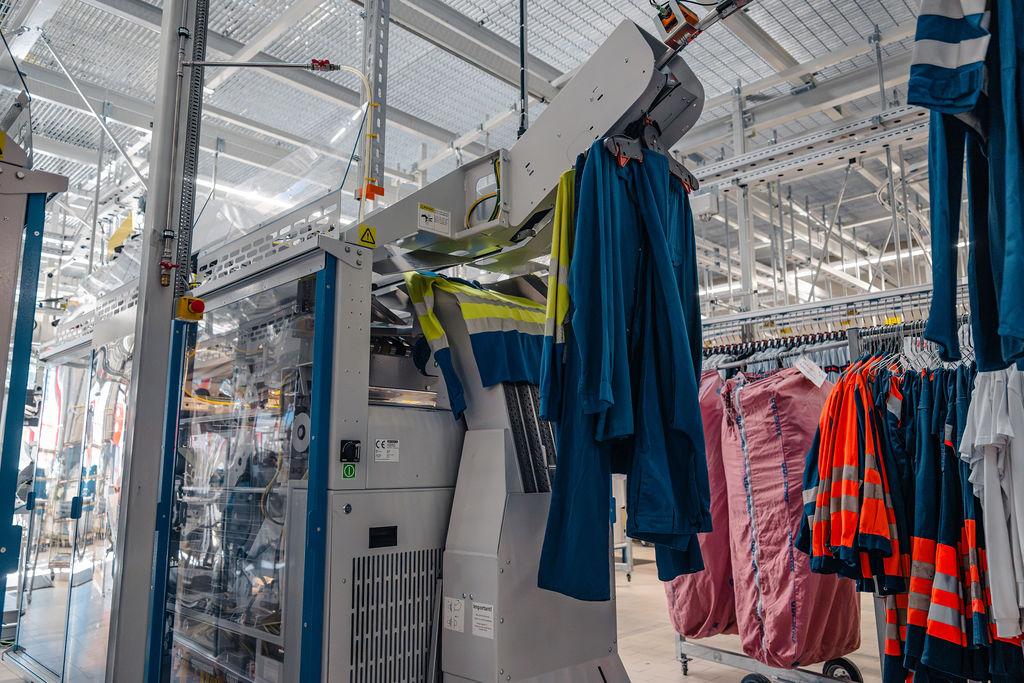
Two JENSEN Fox 1200 folders automatically feed and fold light and heavy garments, preparing them for dispatch.
 oktober 2026
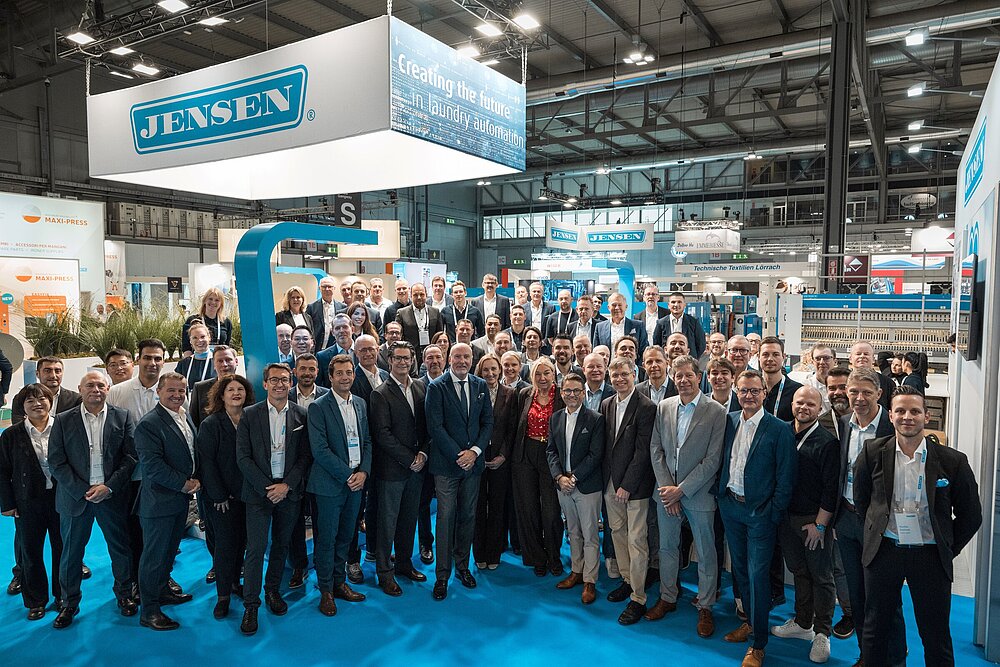
EXPOdetergo International 2026 has come to a close, and we are looking back on an incredible few days in Milan.
 oktober 2026
Industrial laundries are under pressure from every direction: skilled labour is difficult to find, production requirements are increasing, and manual soil sorting remains…
 oktober 2026
De JENSEN-GROUP nodigt wasserijprofessionals uit naar stand R11 T20 op EXPOdetergo International 2026, waar JENSEN en Inwatec laten zien hoe automatisering, robotica en…
 oktober 2026
The JENSEN-GROUP and Wilhelm Bringewatt, founder of Bringewatt Beratung, have agreed to collaborate on the development of forward-looking solutions for a more sustainable…
 oktober 2026
In this edition of Espresso Insights, we sit down with Matteo Gerosa, General Manager of JENSEN Italy, to talk about his daily role, the opportunities and challenges of…

