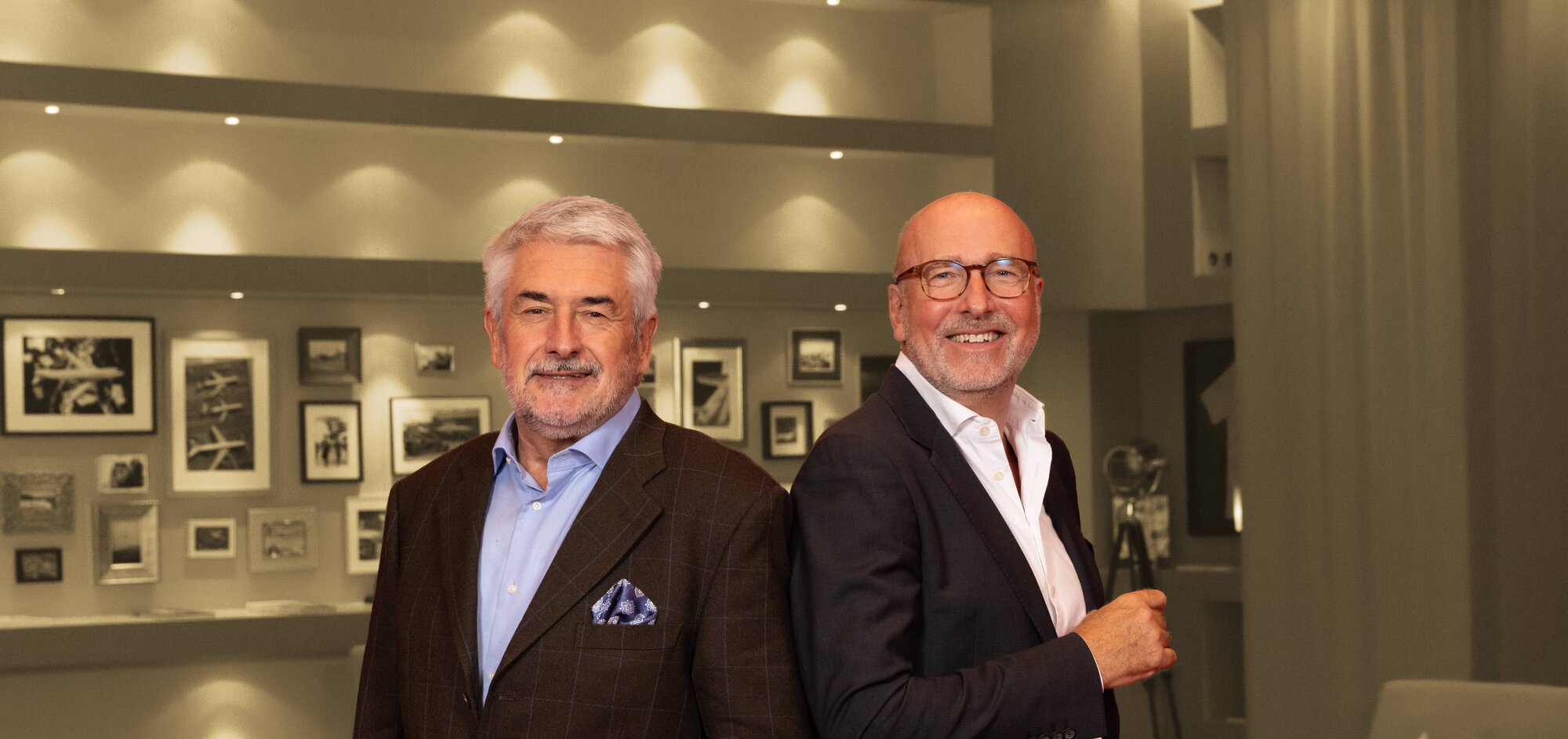
Interview with Rudy Provoost, Chairman, and Jesper Jensen, CEO of the JENSEN-GROUP.
“Entrepreneurship is not just about making money together”
The laundry drum is spinning faster and faster at the JENSEN-GROUP. The global expansion strategy of the Danish supplier of industrial laundry systems is driving sales and profits upward. Over the past four years, the share price has tripled.
“We are growing faster than gross domestic product and faster than our competitors. And this growth is sustainable,” says CEO Jesper Jensen.
CEO Jesper Jensen and Chairman Rudy Provoost were confined to their homes during the height of the COVID-19 crisis when they agreed on a big hairy audacious goal for the group. “COVID forced us to thoroughly evaluate our strategy. Our sales took a 30 percent hit and no orders came in for three months. We decided to set the bar high: the goal was to double sales and triple profits. We were very ambitious, but we achieved it faster than expected. Entrepreneurship is not just about making money together. You also have to dare to dream together,” says Jesper Jensen. The company used the crisis to eliminate a great deal of unnecessary complexity from the organization. “We threw overboard everything the company did not need. We kept sales and service intact, but everything without added value was overhauled. We are still reaping the benefits of that today.
“The focus is on the things that matter,” says Rudy Provoost. The strategic exercise of 2020 is followed up each year in a two-day strategy workshop with management and the board. “Over the past five years, we have made many adjustments because of geopolitical and technological changes. This agility characterizes our pragmatic approach. We were the first to move to China in 2011. In 2018, we integrated robotics and artificial intelligence (AI) into our systems for the first time. And as early as 2021, we concluded that we needed production capacity in the United States,” says Jesper Jensen.
Riding megatrends
The coronavirus crisis and the bottlenecks in supply chains that followed hit the JENSEN-GROUP hard, but since 2022, the laundry loads have been getting bigger and bigger. Over the past four years, sales have more than doubled as planned, and operating profit has tripled. “We are growing faster than our competitors, and we can sustain that growth. However, growth never follows a straight line. If we can stabilize our sales at around 600 million euros this year, we have done a good job and are ready for the next step. Our objective is to grow slightly faster than our customers,” explains Jesper Jensen.
The JENSEN-GROUP makes money from the production, installation, and maintenance of industrial laundry systems. Being close to the customer, providing good service, and extensive automation are the basic principles of the strategy, which is being rolled out worldwide. “Today, we are number one or two in our main markets and we are still gaining market share. We have a strong local presence in every important region, which is crucial in a fragmented world. We have doubled our production capacity through acquisitions in order to make that growth possible. Thanks to our economies of scale, we can serve our customers better and faster,” says Rudy Provoost.
The customers are companies that rent textiles and linens to hotels, restaurants, or other businesses. In addition, the JENSEN-GROUP supplies hospitals and large hotels that have their own laundry facilities, as well as cruise lines that need to equip their ships with washing machines. Demand for industrial laundry systems is structurally increasing.
“We are riding a number of megatrends,” says Jesper Jensen. “Tourism is growing rapidly. By 2050, the aviation industry could double in size. More travel also means growth for the hospitality industry. Driven by an aging population, demand from the healthcare sector is increasing, especially in Europe, but also in the United States and Asia. China’s population is aging as well, and Chinese families no longer take care of elderly people at home. That task is increasingly being outsourced to care centers.
More and more employees wear uniforms, which have to be washed regularly. And worldwide, demographic and political developments are creating a growing labor shortage, forcing our customers to automate. All these trends are positive for us. Our end markets are growing faster than gross domestic product. Our customers are profitable, have good cash flow, and are growing.”
East and west
Acquisitions are an important engine of growth. “Growth is in our DNA. My father and I made our first small acquisition in 1994. At the time, we had sales of 40 million euros. Since then, we have completed thirty acquisitions, an average of one per year. A successful acquisition ultimately results in organic growth. We fuel our growth engine by completing acquisitions,” says Jesper Jensen.
Through acquisitions, the JENSEN-GROUP is efficiently building a global production and distribution structure. “We are a global player thanks to our strong local roots. The world has changed significantly from a geopolitical perspective. We have no control over three factors: tariffs, transportation costs, and exchange rates. We are less dependent on these costs if we produce and sell locally,” says Rudy Provoost.
A strong local presence is also strategically important in order to serve customers well. “We operate in a niche industry. Laundry systems are tailored to the customer. Our engineering teams know how to adapt our products to local markets and needs. That is how we distinguish ourselves from the competition,” says Rudy Provoost.
Service is also a source of recurring revenue. The acquisition of German Maxi-Press, a distributor of consumables for the industry, in 2024 fits into this strategy. “It is a business that requires little investment and therefore offers a high return on invested capital. In this way, we improve our service and increase our recurring revenue,” says Jesper Jensen.
For its international expansion, JENSEN-GROUP is looking both east and west. The move east received a major boost in 2023 with the joint venture the company entered into with its Japanese peer Miura, which acquired a 20 percent stake in the JENSEN-GROUP through the deal.
“Through this cooperation, we are the only non-Japanese company active in the Japanese industrial laundry market, which is one of the largest in the world,” says Rudy Provoost. JENSEN-GROUP has had a strong foothold in China since 2011. “We are the only European company with production capacity in China. Our position there is really starting to pay off. We own 100 percent of our Chinese subsidiary. We do not want a joint venture in China because you know that local companies copy everything. But, in fact, they copied everything anyway; it just took longer. On the Chinese market, we compete with Chinese peers that are also active in international markets. We take that competition very seriously, but they still need to build up their international distribution and service,” says Jesper Jensen.
At the end of 2025, the JENSEN-GROUP took an important step westward with the acquisition of American G.A. Braun. “We already knew in 2021 that we needed production capacity in the United States. It took four to five years, but we succeeded. That acquisition strengthened our position. We see a great deal of potential in the American market, which is by far our largest market, with sales of 130 to 140 million dollars,” says Jesper Jensen.
The JENSEN-GROUP is debt-free. Could greater financial leverage accelerate growth even further? “It takes two to tango. The shareholders of an acquisition target must be open to a sale. An acquisition is often a succession issue. When the owner reaches a certain age and the family does not want to continue the business, an acquisition opportunity arises. Sometimes it may also concern companies that develop a successful product but do not have sufficient distribution capacity,” says Jesper Jensen.
The JENSEN spirit
Acquiring companies is one thing; integrating them successfully is usually much more difficult. “We have become skilled at acquisitions,” says Jesper Jensen. “We can quickly integrate the acquired factories into our structure. Thanks to our plug-and-play model, we do not need to invest large sums. The acquisition of G.A. Braun is a good example. We bought an excellent factory with 230 employees who can weld and build machines. If we had to build that production facility ourselves from scratch, it would take us five to ten years and cost more money.”
The company is growing and changing, but Jesper Jensen emphasizes that the corporate culture has remained intact. “Our structure is open, flat, and lean. As a result, information reaches us with as few steps as possible, allowing us to make decisions based on accurate data. In many large companies, filters and office politics cause you to lose touch with the customer. Our people have a great deal of freedom to do their work, of course within certain boundaries and internal rules. We give them trust and the authority to execute. That makes us an agile micro-version of a multinational. We run JENSEN-GROUP like true entrepreneurs.”
The acquired companies have adopted this “JENSEN spirit.” “‘Culture eats strategy for breakfast,’ Peter Drucker once said. A successful acquisition is not just a matter of strategy, but above all of corporate culture. Mutual respect and trust are central at JENSEN-GROUP. During an acquisition, you have to listen and appreciate the company’s individuality. An accessible corporate culture enables smooth integration and is the best motivator,” says Rudy Provoost.
Keep investing
The success of the JENSEN-GROUP has not gone unnoticed on the stock market. The share price has tripled since 2022. The second-generation family business now has a market capitalization of 735 million euros and is listed on Euronext Brussels, as a result of the merger with Belgian IPSO-ILG in 1999. “My grandfather, Ejnar Jensen, founded the company, but it was merely a store on Bornholm, an island off the Danish coast. My father, Jorn Jensen, started the international expansion. I took over the helm in 1991,” says Jesper Jensen.
The company regularly buys back its own shares. Jesper Jensen also bought more than 10 million euros’ worth of shares in August. “I invest my own money in the company. Why would I invest in other companies if I can achieve an annual return of more than 10 percent with JENSEN-GROUP? We can continue to generate that return, and the best way to do so is to keep investing in JENSEN-GROUP,” says Jesper Jensen.
Jesper Jensen is not interested in achieving greater diversification of the family fortune. “It would be a poor investment decision to sell at a premium of 25 percent. Anyone who invests in us is on the right side. To quote Warren Buffett: diversification is protection against ignorance,” says Jesper Jensen.
The family owns a 44 percent stake in the company. “We feel very comfortable with that. What is good for the family shareholders is good for the other shareholders. Our interests are aligned,” says Jesper Jensen, who also indicates that taking the company private is not on the table. “The stock market listing has helped us establish sound governance. Complying with all the rules forces you to play in the Champions League. I can leave tomorrow knowing that the company will remain in good hands. Not every family owner can say that. Everything is being properly managed by a professional board of directors and professional management.”
In recent months, the share price has lost some momentum. Fewer orders came in during the second quarter, and geopolitical uncertainties led to a more cautious tone for the second half of the year. Is the order intake a concern? “An investor asked the same question. My answer was: ‘So what?’ We are in the project market, which means sales can fluctuate considerably. A strong quarter can be followed by a weaker one, and vice versa,” says Jesper Jensen.
“Of course, we continuously monitor the order book, but we do not need to panic if one quarter produces somewhat fewer orders. Geopolitical turmoil, higher energy prices, and rising interest rates may slow down investments or cause quarterly fluctuations, but at the same time, expensive energy and labor increase the need for energy-efficient, automated laundry systems. That is where our strength lies,” says Rudy Provoost.
Automation as a calling card
JENSEN-GROUP has been focusing on automation for many years. “We sell productivity. We sell our customers the opportunity to use less labor, energy, and water. Our systems offer customers a payback period of four to five years. We do not sell payback periods of ten years, except when replacing systems because maintenance has become too expensive,” says Rudy Provoost.
The company also sells operational reliability, emphasizes Jesper Jensen. “Our customers need to be able to operate six or seven days a week, often with two shifts per day. They cannot afford for their washing machines to break down. Just imagine if a cruise ship could not wash the linens of five thousand passengers. That would be catastrophic. This applies to all our customers. We have an extensive service organization and can quickly supply spare parts for machines that are twenty to thirty years old. Our infrastructure, which we have built up over the past decades, is very strong.”
Since 2018, the company has been accelerating its focus on robotics and artificial intelligence. At that time, it acquired a 30 percent stake in Danish Inwatec, which develops technology for the industry. That stake was increased to 70 percent in 2021 and to 100 percent last summer. “We are digitizing laundry. It is as if we are adding Google to our industry. Inwatec’s founder, Mads Andresen, wanted to be paid in Jensen shares for the acquisition because he believes in our company. Today, Mads is our chief innovation officer and responsible for our European business,” says Jesper Jensen.
Sorting the laundry, washing, and drying are fully automated. “The linens are not touched by human hands again until the end of the process. We introduced automatic sorting in 2018, as the first company in our industry. The competition is not standing still, but neither are we. The next step is to automate the final process, including quality control,” says Jesper Jensen.
High-performance systems are also sustainable systems. Jesper Jensen: “Our industrial systems wash much more sustainably than household washing machines. A washing machine at home uses 30 liters of water per kilogram of laundry; our industrial systems use only 2 to 3 liters. Energy consumption is also drastically lower. We want to reduce that consumption by another 20 to 30 percent over the next five to ten years.”
Interview with Rudy Provoost, Chairman, and Jesper Jensen, CEO of the JENSEN-GROUP.
Published in “Trends”, leading Belgian business and economic magazine, published weekly in Flanders - translation of the Dutch original
Source: De wastrommel draait steeds harder bij Jensen-Group: 'We kunnen onze groei volhouden'
Sincere thanks to Daan Killemaes, Chief Economist at “Trends”.
For further information, please reach out to Scarlet Janssens, Head of Treasury & Investor Relations.

